


“Why is my tool running out of true?” – “Why is the spindle suddenly vibrating?” Every machinist knows these questions. The cause usually lies in a damaged tool cone. The solution is a tool assembly station without cone damage that protects the precision cone while enabling ergonomic tool changes. But how does such damage occur in the first place, and how can it be permanently avoided?
Problem 1: Cone Damage from Incorrect Clamping
The most common source of error in tool mounting is directly clamping the toolholder in a vise. The precision-ground cone according to ISO 7388 is squeezed by the vise jaws, leading to microscopic deformations. These are often invisible to the naked eye but cause significant problems:
- Imbalance in the machine spindle
- Vibrations during machining
- Poor surface quality
- Premature tool wear
- Reduced tool life
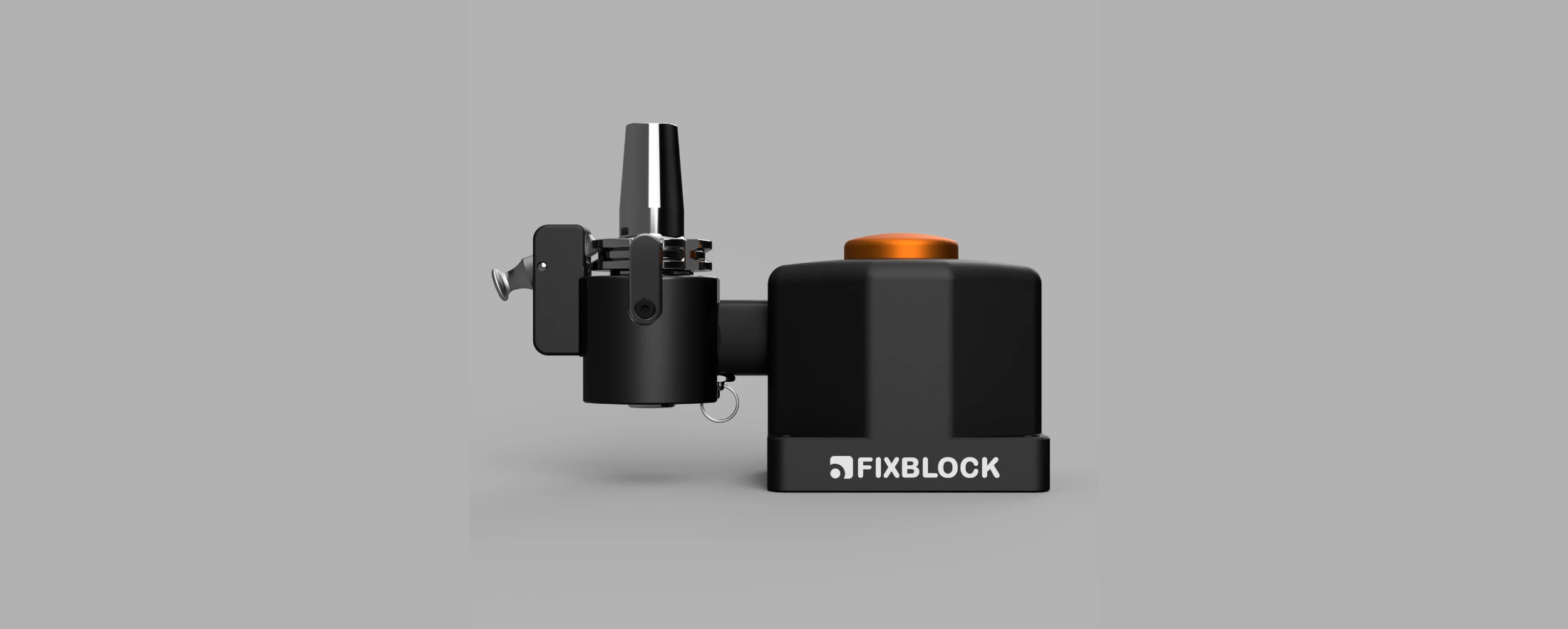
The Solution: A professional tool assembly station without cone damage clamps the toolholder below the cone. The FBL Fixblock secures the holder at the receiving area or flange, leaving the cone completely free and protected.
Problem 2: How Do I Safely Hold Heavy Toolholders During Tool Changes?
Anyone who has ever held an SK50 or HSK-A100 toolholder knows the problem: these parts weigh several kilograms. While trying to screw in the cutting tool, you must simultaneously hold the heavy holder. This leads to:
- Cramped hands and wrists
- Back pain from awkward posture
- Accident risk from slipping
- Imprecise screw connections
The Solution: A stationary tool holding fixture like the FBL Fixblock holds the toolholder firmly in place. Both hands remain free for mounting the cutting tool. The working height can be optimally adjusted, relieving strain on back and wrists.
Problem 3: Why Does My Tool Slip When Tightening?
Many users report that the toolholder rotates or tilts when firmly tightening the tool screw. This happens particularly often when the holder is placed provisionally on the workbench or held with just one hand. The consequences:
- Tool screw is tightened at an angle
- Tool does not sit flat on the contact surface
- Uneven force distribution
- Increased risk of tool breakage
The Solution: The FBL Fixblock secures the toolholder absolutely rigid. This stationary tool assembly station guarantees that everything stays in place even at high tightening torques. The solid steel construction ensures nothing slips or tilts.
Problem 4: Space Constraints in the Workshop
Mobile tool assembly aids with swivel functions require considerable space – not only during use but also for storage. However, in many workshops, every square meter is valuable. Mobile systems often get in the way, must be constantly moved, and occupy space needed for other purposes.
The Solution: The FBL Fixblock is permanently mounted to the workbench and stays there. As a stationary tool assembly station, it only requires the space it actually occupies – no swivel range, no storage space. The workshop remains organized and the Fixblock is always immediately accessible.
Tool Assembly Station Without Cone Damage: Stationary vs. Mobile Comparison
In workshops with multiple CNC machines, different tool systems are often used: SK40, HSK-A63, VDI 30, and others. With mobile mounting systems, this means constantly changing adapter heads. This costs time and creates potential errors:
- Wrong adapter mounted
- Adapter not properly locked
- Time lost searching for the right head
The Solution: If your workshop primarily works with one interface, a specialized tool assembly station without cone damage like the FBL Fixblock is the better choice. Once mounted, it is always ready for use – no adapter changes, no adjustments. For multiple interfaces, several Fixblocks can be mounted side by side on the workbench, each optimally configured for its system.
Ergonomics and Occupational Safety in Tool Changing
Occupational health studies by the German Social Accident Insurance (DGUV) show: repetitive strain during tool changes leads to long-term complaints in hands, wrists, and shoulders. It becomes particularly critical when heavy toolholders must be mounted multiple times daily. Additionally, there is accident risk:
- Toolholder slips and falls on feet
- Cutting tool injures hand when slipping
- Cramped posture leads to muscle strains
The Solution: A permanently mounted tool holding fixture without cone damage eliminates these risks. The FBL Fixblock holds the toolholder at optimal working height, both hands remain free and can work safely. Accident risk decreases, ergonomic strain is minimized.
Step-by-Step: How to Use Your Tool Assembly Station Without Cone Damage
1. Insert Toolholder: Place the toolholder into the Fixblock’s receptacle. The cone points upward and remains completely free.
2. Secure: Depending on the design, the toolholder is secured by a lever or clamp. Ensure the holder sits firmly and does not wobble.
3. Insert Tool: Guide the cutting tool into the tool receptacle. Pay attention to clean contact surfaces – chips or dirt lead to imbalance.
4. Screw: Tighten the tool screw to the specified torque. Since the toolholder is secured, you can use both hands for the screwing operation.
5. Check: Before removal, verify that the tool sits flat and the screw is tight.
FBL Fixblock: The Stationary Solution for Cone-Protecting Assembly
The FBL Fixblock from SCHLEIF-TEC is specifically designed for workshops that rely on a standardized tool interface. Unlike mobile mounting systems, the Fixblock is permanently mounted to the workbench and therefore:
- Always immediately ready for use
- Space-saving and organized
- Ergonomically optimally positionable
- Absolutely stable and torsion-resistant
Manufacturing takes place in Austria according to the highest quality standards. Through direct sales via spannsysteme.shop, dealer margins are eliminated – you receive Austrian precision at transparent prices.
Which Tool Assembly Station Without Cone Damage Fits Your Production?
A permanently mounted Fixblock is particularly suitable for:
- Series Production Operations: When the same tool systems are used daily
- Tool and Die Making: When specific interfaces are the focus
- Maintenance: When standardized tools are serviced
- Training Workshops: When a uniform system is employed
If, on the other hand, you switch between different interfaces daily, a modular mounting system with interchangeable heads may make more sense. For all other cases, the stationary tool holding fixture offers the more efficient, ergonomic, and durable solution.
Conclusion: Investment in Precision and Occupational Safety
Cone damage, ergonomic problems, and safety risks during tool changes can be avoided with the right tool assembly station without cone damage. The FBL Fixblock offers a permanent, stable solution for all who value precision, occupational safety, and efficiency.
Further information on ergonomic workplace design can be found at the Federal Institute for Occupational Safety and Health (BAuA).
Protect your tool cone, relieve strain on your employees, and increase the quality of your production. Discover the FBL Fixblock now: